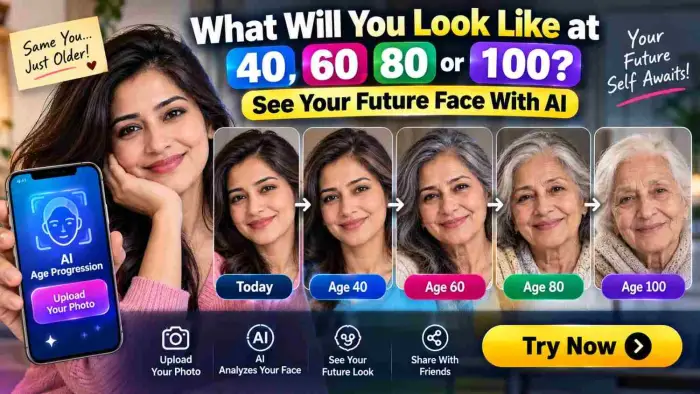
What Will You Look Like at 40, 60, 80 or 100? See Your Future Face With AI
Have you ever looked at a recent photo and wondered, “What will I look like when I am much older?” Maybe you want to see yourself at 40, 60, 80, or even 100 years old.
Until recently, imagining your future appearance mostly depended on guesswork. Today, AI-powered age progression tools can create a surprisingly detailed older version of your face within seconds.
These tools combine artificial intelligence, facial analysis, image processing, and generative AI to simulate how your appearance could change over time. The result is not a guaranteed prediction, but it can offer a fascinating glimpse of one possible future version of you.
What Is AI Age Progression?
AI age progression is a photo-editing technology designed to make a person appear younger or older.
You normally start by uploading a clear photograph. The AI analyzes different facial features, including your eyes, cheeks, forehead, jawline, hair, and skin texture.
It then creates an edited version of your face by adding visual characteristics commonly associated with different age groups.
Depending on the tool, you may be able to generate several versions of the same photograph.
| Future Age | What AI May Change |
|---|---|
| Age 40 | Subtle facial maturity, skin texture and hairstyle |
| Age 60 | Gray hair, facial lines and mature contours |
| Age 80 | Stronger aging effects and softer facial structure |
| Age 100 | Dramatic age progression and advanced facial changes |
This makes it possible to create an entire visual timeline from your current appearance to a much older version.
How Might You Look at Age 40?
For younger users, an age-40 simulation often creates relatively subtle changes.
Instead of dramatically transforming the face, AI may make the skin slightly more mature, modify the hairstyle, add very small facial lines, or change certain contours around the eyes and cheeks.
Because the changes are less extreme, an age-40 result can sometimes appear more believable than very advanced aging filters.
It can also be interesting to compare your AI-generated appearance with older family members to see whether the software creates any similarities.
What Could Your Face Look Like at 60?
This is where AI aging becomes much more noticeable.
A 60-year-old simulation may introduce gray or white hair, more visible lines around the eyes and forehead, changes around the mouth, and a slightly different facial structure.
Advanced AI photo editors try to maintain the person's original identity while applying these effects.
That is important because simply adding wrinkles to a photograph does not necessarily create a realistic older face. Modern generative AI can analyze the complete facial structure before generating the final image.
What About Your Face at Age 80?
Age 80 is one of the most interesting stages to experiment with.
The difference between your current photograph and an AI-generated 80-year-old version may be dramatic.
The software can modify hair density, skin appearance, facial volume, wrinkles, eyebrows, and other small characteristics.
However, remember that the result is still an AI simulation.
Lifestyle, genetics, healthcare, skincare, environmental exposure, and many other factors influence how people actually age.
Two people of the same age can look completely different.
Can AI Show You at 100 Years Old?
Yes, some AI face generators allow extremely advanced age progression.
A 100-year-old simulation can create a dramatic transformation and is often used mainly for entertainment or social-media content.
The AI may generate white hair, deeper facial lines, changes in the cheeks and jaw, and other characteristics associated with advanced age.
Because predicting someone's appearance many decades into the future is impossible, these images should be treated as creative interpretations rather than accurate forecasts.
Still, comparing a current selfie with an AI-generated 100-year-old face can be extremely interesting.
How to Create Your Future Face
You do not need professional photo-editing skills.
Start with a clear, front-facing selfie. Natural lighting usually works best because the AI needs to identify your facial features correctly.
Upload the image to an AI age progression or future-face tool and choose the age you want to simulate.
Depending on the application, you may see options such as Older, Senior, Future Face, Age Progression, or similar effects.
Allow the software to process the image and then compare the result with your original photo.
For an even more interesting comparison, generate several ages using the same photograph.
For example:
Today → Age 40 → Age 60 → Age 80 → Age 100
This creates a complete AI-generated aging timeline.
How to Get More Realistic Results
Image quality matters.
Use a photograph where your entire face is visible and avoid sunglasses, heavy filters, extreme angles, or very dark lighting.
A neutral expression can also help some AI models analyze facial geometry more accurately.
You can try the same photograph with several AI tools because each model may produce a different result.
One program may focus heavily on wrinkles while another may make more realistic changes to hair, facial volume, and skin.
Is Your Future Face Actually Accurate?
AI cannot know exactly how you will look decades from now.
Age-progression software works using patterns learned from large amounts of facial data. It estimates how facial characteristics may change as someone becomes older.
Your actual appearance will depend on factors the AI cannot perfectly predict.
That includes genetics, nutrition, lifestyle, environment, healthcare, cosmetic treatments, hairstyles, and natural biological differences.
Think of the image as an AI-generated possibility, not a photograph of your actual future.
Privacy Before Uploading Your Photo
Before using any AI face application, check how it handles uploaded images.
Read its privacy policy, permissions, data-storage information, and account settings.
Some services process photos through cloud-based AI systems, so it is worth understanding whether uploaded images are stored and how they may be used.
Avoid uploading photographs containing sensitive documents, personal information, or private details in the background.
Choosing a trustworthy service is just as important as getting a realistic result.
Why Future-Age Photos Are So Addictive
The appeal is simple: everyone knows what they look like today, but nobody knows exactly what they will look like decades later.
That gap creates enormous curiosity.
Seeing yourself at 40 may feel believable. Seeing yourself at 80 can be surprising. Seeing yourself at 100 can feel almost like meeting another version of yourself.
AI makes that experience possible within seconds.
Final Thoughts
AI age progression gives you a fun way to explore different stages of your future appearance.
Whether you choose age 40, 60, 80, or 100, every result may look slightly different depending on the AI model being used.
The technology cannot predict your future with certainty, but it can create an entertaining and surprisingly realistic simulation.
So take a clear selfie, choose your future age, and see what AI imagines for you.
Frequently Asked Questions
Can AI show me what I will look like at 60?
AI can generate a realistic-looking age progression, but it cannot guarantee your real appearance at 60.
Can I see myself at different ages using one photo?
Yes. Many AI tools can create several age variations from the same photograph.
Which age gives the most realistic result?
Moderate age progression, such as 40 or 60, may sometimes look more natural because fewer extreme changes are required.
Can an AI future face be completely accurate?
No. Your real appearance depends on genetics, lifestyle, environment, healthcare, and many other factors.
Should I upload my photo to any AI website?
No. Check the service's privacy policy and image-storage practices before uploading personal photographs.