FaceApp vs YouCam Makeup vs Future Self AI Tools: Which Gives the Most Realistic Future Face?
AI face-aging tools have become one of the most interesting ways to imagine what you could look like decades from now. Upload one selfie, select an aging effect, and within seconds an app can create an older-looking version of your face.
But not every AI future-face tool produces the same kind of result.
Some apps focus on realistic facial aging, while others offer beauty editing, hairstyles, makeup, avatars, or dramatic future transformations. That makes choosing the right tool important if your goal is a natural-looking image rather than an exaggerated filter.
In this guide, we compare FaceApp, YouCam Makeup, and Future Self–style AI tools to see which type of platform may give the most realistic future-face experience.
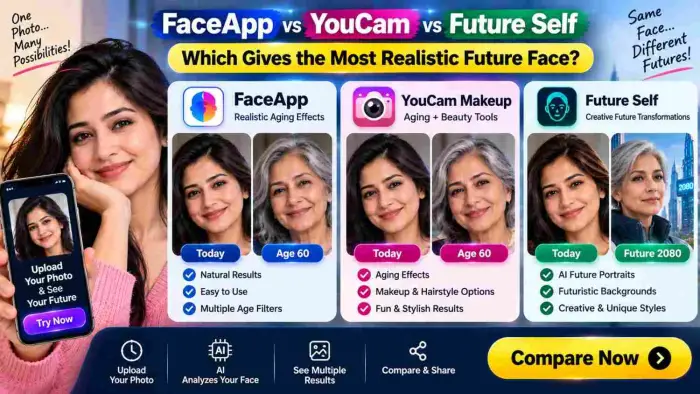
FaceApp vs YouCam vs Future Self: Quick Comparison
| Tool | Best For |
|---|---|
| FaceApp | Realistic and quick facial aging |
| YouCam Makeup | Aging plus beauty and hairstyle experiments |
| Future Self AI tools | Creative future-age and lifestyle transformations |
| FaceApp-style filters | Simple before-and-after comparison |
| Avatar-based AI | Futuristic and highly stylized results |
Features may differ depending on the app version, device, region, and subscription plan.
1. FaceApp: Best for Simple Realistic Aging
FaceApp became widely known for facial transformation effects, especially its older-face filters.
The biggest advantage is simplicity.
You normally upload a clear portrait, choose an aging-related effect, and the software automatically modifies several facial features.
Instead of placing obvious wrinkles over the photograph, AI-based processing may change:
- Skin texture
- Hair color
- Facial lines
- Cheeks
- Forehead
- Eye area
- Overall facial maturity
Because the original facial structure often remains recognizable, the result can feel surprisingly natural.
For users who simply want to answer the question, “What might I look like when I am older?”, this type of tool can be a good starting point.
2. YouCam Makeup: Best for Future Style Experiments
YouCam Makeup takes a broader approach.
Rather than focusing only on age progression, it combines AI-powered photo editing with virtual beauty, hairstyle, makeup, and portrait tools.
This means you can experiment with more than just wrinkles or gray hair.
For example, you could imagine yourself at an older age while also trying:
- Different hairstyles
- Hair colors
- Makeup styles
- Skin effects
- Portrait enhancement
- Other AI transformations
This can make the experience more interesting if you want to imagine your complete future appearance.
Someone may look very different at age 60 depending on hairstyle, grooming, makeup, or fashion. A platform offering several editing tools allows you to explore these possibilities.
However, heavy beauty enhancement can sometimes make an aging result appear less natural.
For the most realistic output, use minimal additional filters.
3. Future Self AI Tools: Best for Imagination
Future Self–style applications take the idea of age progression one step further.
Instead of only asking, “How old will my face look?”, these tools may generate a broader interpretation of your future self.
Depending on the platform, this could include:
- Different age stages
- Future hairstyles
- New clothing
- Career-themed portraits
- Futuristic environments
- AI avatars
- Creative 2080-style backgrounds
This makes them ideal for curiosity-driven images and social-media content.
Imagine uploading a present-day selfie and generating a version of yourself as an older person standing inside a futuristic city in 2080.
That is much more dramatic than a normal aging filter.
The trade-off is realism.
The more creative freedom an AI generator uses, the less likely the image is to resemble a natural photograph of how you may actually age.
Which One Looks the Most Natural?
For a simple aging transformation, dedicated face-aging tools often produce the most natural-looking results.
Why?
Because their main job is to preserve your current facial identity while gradually changing characteristics associated with age.
A generative avatar tool may completely redesign your hairstyle, clothing, lighting, facial expression, or even facial proportions.
That might look impressive, but it can reduce realism.
If your main objective is realistic age progression, choose a tool that makes subtle facial modifications.
If your objective is creative future-self content, an AI avatar or Future Self generator may be more entertaining.
How to Test Which App Is Better
There is a very simple way to compare AI tools fairly.
Use exactly the same photograph in every app.
Choose a photo with:
- Good lighting
- A front-facing pose
- No sunglasses
- No heavy beauty filter
- Your complete face visible
- A relatively neutral expression
Then create an older version using each platform.
Put the images next to one another and compare them.
Look specifically at the eyes, jawline, cheeks, forehead, hair, and skin.
A realistic transformation should still look like you, rather than an unrelated older person.
What Makes an AI Aging Result Look Realistic?
Realistic aging is more complicated than simply adding wrinkles.
As people age, several facial characteristics can change together.
Skin texture changes, hair may become gray, facial volume can shift, and the areas around the eyes and mouth can appear different.
Good AI image-processing software tries to combine these effects rather than exaggerating one feature.
Lighting also matters.
If the original photo is poorly lit, the generated image may contain strange shadows, distorted skin, or unnatural details.
A high-quality source image usually gives AI more useful visual information to work with.
Are Premium AI Features Better Than Free Ones?
Not always, but premium plans may provide additional options.
A paid plan could include:
- Higher-resolution exports
- More AI filters
- Faster processing
- Fewer advertisements
- Additional aging styles
- Advanced photo editing
For casual experimentation, however, free features may already be enough.
Before purchasing any subscription, compare the free results and check exactly what additional functionality the premium plan offers.
Privacy Matters When Uploading Your Face
AI face editing involves personal images, so privacy should never be ignored.
Before using any app, review its privacy policy and permissions.
Check whether the service explains:
- Where images are processed
- Whether uploaded photos are stored
- How long data is retained
- Whether data may be used to improve AI systems
- Whether users can request deletion
Avoid uploading images containing sensitive documents, home addresses, financial information, or other personal details in the background.
Can Any App Truly Predict Your Future Face?
No.
Even the most realistic AI aging software cannot know exactly how you will look in 20, 40, or 60 years.
Your real appearance will depend on genetics, lifestyle, environment, nutrition, health, skincare, hairstyle, and many other factors.
These apps create visual simulations, not guaranteed predictions.
That is why two different AI platforms can generate completely different versions of your future face from the same photograph.
Final Verdict
If you want a straightforward and natural-looking aging effect, a FaceApp-style aging tool may be the better choice.
If you want to combine age progression with hairstyles, makeup, and other appearance experiments, YouCam-style editing tools provide more flexibility.
And if you want to imagine yourself living in 2080 with futuristic clothes, backgrounds, and dramatic AI transformations, Future Self or AI avatar generators can be the most entertaining option.
The best approach is to use the same selfie in multiple tools and compare the results yourself.
You may be surprised by how differently each AI imagines your future.
Frequently Asked Questions
Which AI tool gives the most realistic older face?
Dedicated facial-aging tools generally focus more on realistic age progression, although results vary by photograph and AI model.
Is YouCam only for makeup?
No. Its broader AI photo-editing tools can include multiple appearance and portrait transformations.
Are Future Self generators realistic?
Some results can look realistic, but many are designed for creativity and entertainment rather than accurate age prediction.
Should I use the same photo when comparing apps?
Yes. Using one identical photograph makes it easier to compare how each AI model processes your face.
Can AI accurately show how I will look in 2080?
No. AI can create a possible visual interpretation, but it cannot guarantee your actual future appearance.