Can AI Really Predict Your Face in 2080? How Future Face Technology Actually Works
Have you ever looked at an AI-generated future photo and thought, “Will I really look like this in 2080?”
AI aging apps can now take a normal selfie and create an older-looking version of your face within seconds. The result may show gray hair, wrinkles, changed facial structure, or even a completely different style.
Some images can look surprisingly realistic. But there is an important difference between an AI prediction and an AI simulation.
AI can estimate how your appearance might change based on patterns it has learned, but it cannot see your actual future. Here is what future-face technology can—and cannot—really predict.
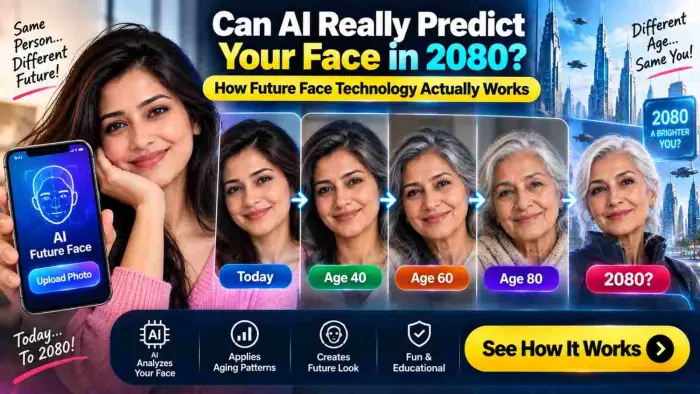
How Does AI Create Your Future Face?
AI future-face tools generally begin by analyzing the photograph you upload.
The software may identify facial characteristics such as:
- Eyes
- Nose
- Lips
- Jawline
- Cheeks
- Forehead
- Hair
- Skin texture
- Overall face shape
After analyzing these features, the AI applies aging patterns learned from large collections of facial images or other training data.
The result is a newly generated or edited portrait designed to look like an older version of the original person.
This entire process can happen in just a few seconds.
AI Prediction vs Real Future Appearance
| AI Can Estimate | AI Cannot Know |
|---|---|
| Possible wrinkles and facial lines | Your exact appearance in 2080 |
| Gray or white hair | Your future hairstyle |
| General facial aging patterns | Your future lifestyle |
| Changes in facial volume | Future medical or cosmetic treatments |
| Older-looking skin texture | Exactly how your genetics will affect aging |
| Creative future appearance | What will actually happen decades from now |
This distinction is important.
A realistic-looking image is not necessarily an accurate prediction.
Why Can AI Aging Look So Real?
Modern AI image-generation systems have become extremely good at creating realistic human faces.
The software has learned visual patterns associated with age.
For example, older faces often have different skin texture, facial volume, hair color, and lines around the eyes and mouth.
AI can apply many of these changes at the same time.
That is why the result can sometimes look far more convincing than a simple photo filter.
A traditional filter might only add wrinkles.
A more advanced AI system may change the hair, cheeks, eyes, jawline, skin, and lighting together while trying to keep the person recognizable.
What Determines How You Will Actually Age?
Your real appearance decades from now depends on much more than your current selfie.
Genetics plays an important role, but it is only one factor.
Your future appearance may also be affected by:
- Diet
- Sleep
- Exercise
- Sun exposure
- Stress
- Smoking or alcohol use
- Skincare
- Medical treatment
- Environment
- Hair and grooming choices
- Cosmetic procedures
AI usually does not know exactly how these parts of your life will change.
That makes a precise 2080 prediction impossible.
Can Family Photos Help AI Predict Aging?
Family photographs can give people an interesting idea of how certain traits may change with age.
For example, you may notice similarities between your face and an older parent or grandparent.
However, even people from the same family can age differently.
An AI model may recognize common aging patterns, but it cannot perfectly predict which genetic characteristics will become more noticeable in one individual.
So even if an AI future face resembles an older family member, that should still be treated as an interesting possibility rather than proof.
Why Do Different Apps Give Different Results?
Try the same selfie in several AI aging apps and you may get completely different future faces.
One app may give you more wrinkles.
Another may change your face shape.
A third may give you white hair and a much older appearance.
This happens because different platforms use different AI models, image-processing systems, training methods, and creative settings.
There is no single universal formula for generating a future face.
The differences between apps are actually part of what makes experimenting with them interesting.
Can AI Predict Your Face at 40 or 60 Better Than 2080?
Generally, shorter-term age progression may appear more believable because fewer dramatic changes are required.
If someone is currently 25, generating a version at 40 involves a much smaller time difference than predicting how that person will look at 90 or 100.
The further into the future the simulation goes, the more uncertainty there is.
That means an age-40 or age-50 image may look plausible, while a 2080 image should be considered much more speculative.
What Makes a Future Face Result More Realistic?
Start with a high-quality photograph.
A front-facing image with clear lighting gives the AI more facial information to work with.
Avoid heavy beauty filters, sunglasses, blurred photos, or extreme camera angles.
You may also get better results if:
- Your entire face is visible
- The background is simple
- Your expression is natural
- The image is sharp
- Lighting is even
Try the same photo in several tools and compare the results.
If multiple AI systems generate similar aging characteristics, the comparison can be interesting—but it still does not make the result a guaranteed prediction.
Are AI Future Face Tools Scientific?
Most consumer future-face apps are primarily designed for photo editing, creativity, or entertainment.
They should not automatically be treated as scientific age-prediction systems.
There are specialized age-progression techniques used in research and professional contexts, but consumer AI apps usually prioritize fast, visually convincing results.
So when an app creates a dramatic 2080 portrait, the best way to interpret it is:
“This is one possible AI-generated version of my future appearance.”
Not:
“This is exactly how I will look.”
Could Future AI Become More Accurate?
AI image technology will almost certainly continue improving.
Future systems may be able to combine more information, such as facial history, family traits, lifestyle data, environmental factors, and higher-quality 3D facial analysis.
That could create more personalized age simulations.
But predicting a person's exact appearance decades into the future would still involve enormous uncertainty.
Human aging is influenced by too many unpredictable variables.
Why Is Seeing Your 2080 Face So Fascinating?
The appeal is not really about perfect prediction.
It is about curiosity.
You already know what you look like today, but the future is unknown.
Seeing an AI-generated older version creates a visual answer to a question you normally cannot answer.
That makes future-face technology perfect for before-and-after images, social posts, creative experiments, and conversations with friends and family.
Final Thoughts
So, can AI truly predict how you will look in 2080?
No—not exactly.
AI can analyze your current face and generate a realistic-looking age progression based on patterns associated with aging.
But your real future appearance will depend on genetics, lifestyle, health, environment, personal choices, and many unpredictable events.
Treat AI future-face images as fascinating simulations rather than guaranteed forecasts.
The technology may not know your future—but seeing what AI imagines can still be incredibly interesting.
Frequently Asked Questions
Can AI accurately show my face in 2080?
No. AI can create an estimated future-face simulation, but it cannot know exactly how you will look.
Why do different AI apps produce different future faces?
Different apps use different AI models, training methods, and image-processing techniques.
Is age 40 easier for AI to simulate than age 100?
A shorter age progression generally involves less uncertainty, so it may appear more believable.
Does genetics determine exactly how I will age?
Genetics matters, but lifestyle, environment, health, skincare, and many other factors also influence appearance.
Are AI aging photos real predictions?
No. They are generated visual possibilities and should primarily be treated as creative simulations.