Best Car Insurance Plans – Compare Coverage, Premium & Benefits
Choosing the right car insurance plan is not only about finding the lowest premium. A good policy should provide suitable coverage, a reasonable insured value, useful add-ons, manageable deductibles, and a claims process that fits your needs.
Car owners generally compare options such as third-party insurance, standalone own-damage cover, and comprehensive or package car insurance. The right choice depends on the vehicle’s age, usage, value, location, driving habits, and the level of financial protection you want.
This guide explains how to compare the best car insurance plans, including coverage, premium, IDV, deductibles, add-ons, No Claim Bonus, and other important benefits.
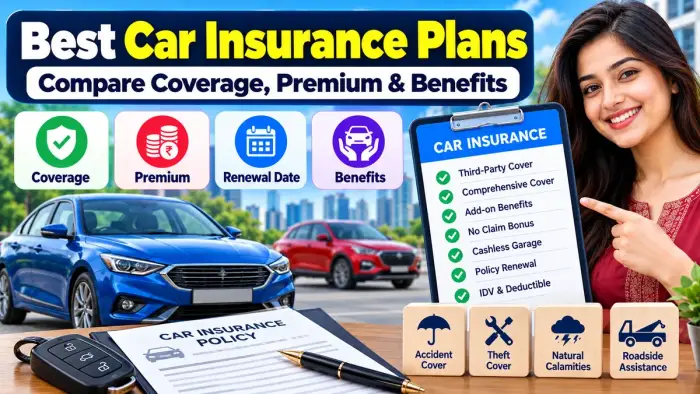
Car Insurance Plans – Quick Comparison
| Insurance Type | Main Coverage | Suitable For |
|---|---|---|
| Third-Party Insurance | Liability toward third parties | Minimum legally required cover |
| Standalone Own-Damage | Damage to your own vehicle | Vehicles already having valid third-party cover |
| Comprehensive / Package Policy | Third-party + own-damage protection | Car owners wanting broader protection |
| Comprehensive + Add-ons | Base cover plus selected extra protections | Newer, valuable or frequently used cars |
Actual coverage depends on the policy terms and exclusions.
1. Third-Party Car Insurance
Third-party motor insurance covers legal liability arising from injury, death, or eligible property damage caused to another person.
Third-party liability insurance is mandatory for vehicles using public roads in India.
This type of policy generally does not cover damage to your own car.
Main Benefits
Meets mandatory third-party insurance requirements
Covers eligible third-party liabilities
Usually costs less than broader policies
Suitable if you only need basic liability protection
Limitation
If your own car is damaged in an accident, flood, theft, fire, or another covered event, a third-party-only policy generally will not pay for damage to your own vehicle.
2. Standalone Own-Damage Insurance
Standalone own-damage insurance is designed to cover eligible damage to your own vehicle when a valid third-party liability policy already exists separately.
Depending on the policy terms, own-damage protection may cover events such as:
Accidents
Theft
Fire
Certain natural calamities
Certain man-made events
Always read the exact policy wording because exclusions and conditions vary.
3. Comprehensive Car Insurance
A comprehensive or package motor insurance policy generally combines:
Third-Party Liability + Own-Damage Cover
This makes it a popular choice for car owners who want wider protection than third-party insurance alone.
A comprehensive plan can be especially useful for:
New cars
Expensive vehicles
Cars used frequently
Vehicles parked outdoors
Cars used in areas prone to flooding or other risks
However, comprehensive insurance does not mean every possible loss is covered. Policy exclusions, depreciation, deductibles, and claim conditions still apply.
Which Car Insurance Plan Is Best?
There is no single policy that is best for every car owner.
A better way to choose is to compare the following:
| Factor | What to Compare |
|---|---|
| Coverage | Third-party, own-damage and included benefits |
| Premium | Total amount payable |
| IDV | Insured Declared Value |
| Deductible | Amount you pay during eligible claims |
| Add-ons | Extra protection available |
| Garage Network | Cashless repair availability |
| Claim Process | Digital and offline claim support |
| Exclusions | Situations not covered |
| NCB | No Claim Bonus eligibility |
| Renewal Terms | Renewal price and policy conditions |
What Is IDV in Car Insurance?
IDV means Insured Declared Value.
It represents the insured value of your vehicle under applicable own-damage coverage and can affect both the premium and the amount payable in certain total-loss or theft situations.
A policy with a very low premium may sometimes have a lower IDV, so you should not compare policies only on price.
Check:
IDV offered
Premium
Deductible
Add-ons
Policy exclusions
Claim-related conditions
IRDAI policy wording indicates that in a total-loss or constructive total-loss situation, insurer liability can be linked to the vehicle's IDV, subject to applicable policy conditions.
What Determines Car Insurance Premium?
Car insurance premium can vary significantly between policyholders.
Common factors include:
Vehicle Model
Expensive vehicles and vehicles with costly spare parts may have higher own-damage premiums.
Vehicle Age
Older vehicles usually have a different IDV and risk profile compared with new cars.
Location
Insurance pricing may differ depending on where the vehicle is registered or mainly used.
Coverage Selected
Third-party-only insurance usually differs in price from comprehensive insurance.
Add-ons
Optional add-ons increase protection but can also increase the premium.
Deductible
Choosing a voluntary deductible may reduce the own-damage premium, but you agree to pay more toward a claim.
Policy documents can include both compulsory and voluntary deductibles, subject to the terms of the specific plan.
Best Car Insurance Add-ons to Consider
Add-ons are optional benefits that can be purchased with eligible own-damage or comprehensive policies.
Availability varies by insurer and vehicle.
Zero Depreciation Cover
Normally, depreciation can reduce the amount payable for certain replaced vehicle parts.
Zero depreciation cover can reduce the effect of depreciation on eligible claims, subject to policy conditions.
It may be useful for newer vehicles.
Roadside Assistance
Roadside assistance may provide support if your car breaks down.
Depending on the plan, services may include:
Towing
Battery support
Emergency assistance
Minor roadside help
Some policy wordings provide towing and roadside assistance benefits within specified limits.
Return to Invoice
Return-to-invoice add-ons may provide additional protection in certain total-loss or theft situations.
Coverage typically depends on strict policy conditions and vehicle eligibility.
Engine Protection
This add-on may cover certain types of engine-related damage that are otherwise excluded from standard own-damage coverage.
It can be particularly relevant for vehicles used in areas where waterlogging is common.
Consumables Cover
Consumables cover may help with eligible items such as oils, lubricants, nuts, bolts, and other consumable components during covered repairs.
Again, exact inclusions vary between insurers.
What Is No Claim Bonus?
No Claim Bonus, commonly called NCB, is a benefit available under eligible own-damage motor insurance when no claim is made during the previous policy period.
Traditional motor policy wording provides an NCB progression that can increase with consecutive claim-free years, subject to renewal and policy rules.
For example, eligible NCB under standard wording may progress from:
| Claim-Free Period | NCB on Own-Damage Premium |
|---|---|
| 1 Year | 20% |
| 2 Consecutive Years | 25% |
| 3 Consecutive Years | 35% |
| 4 Consecutive Years | 45% |
| 5 Consecutive Years | 50% |
The actual benefit should always be verified in your insurer's current policy terms.
Cheap Premium vs Better Coverage
The cheapest car insurance policy is not automatically the best policy.
Imagine two plans:
Plan A
Premium: ₹7,500
Lower IDV
Limited add-ons
Higher deductible
Plan B
Premium: ₹9,000
Better IDV
Zero depreciation
Roadside assistance
Lower deductible
Plan B costs more, but depending on the vehicle and owner's needs, it may provide better value.
That is why car insurance should be compared using coverage-to-cost, not premium alone.
Compare Cashless Garage Network
A cashless garage network can make the repair process more convenient.
At an eligible network garage, the insurer can settle approved repair costs directly with the garage, while the policyholder pays applicable deductibles and uncovered amounts.
Before buying insurance, check:
Whether nearby garages are included
Whether your preferred authorized service centre is available
Claim approval procedure
Cashless repair conditions
A large network can be useful, but the quality and convenience of garages near your location matter more than the total number advertised.
What Is a Deductible?
A deductible is the portion of an eligible claim that the policyholder has to bear.
There may be:
Compulsory deductible
Voluntary deductible
A higher voluntary deductible can lower the premium, but it also means you may need to pay more from your pocket when making an eligible claim.
IRDAI-filed policy wording confirms that voluntary deductibles may provide a discount on the own-damage premium, depending on the plan.
How to Compare Car Insurance Before Buying
Follow this simple checklist.
Step 1: Decide the Coverage Type
Choose between third-party, standalone own-damage, or comprehensive protection.
Step 2: Compare Similar Policies
Do not compare a basic policy from one insurer with a premium policy containing multiple add-ons from another.
Make sure coverage levels are similar.
Step 3: Check IDV
Compare the IDV being offered for your car.
Step 4: Review Add-ons
Select add-ons based on your vehicle and actual requirements rather than buying every available option.
Step 5: Compare Deductibles
A cheap policy with a high deductible may cost more during a claim.
Step 6: Check Garage Availability
Confirm whether convenient nearby garages support cashless claims.
Step 7: Read Exclusions
Exclusions can be just as important as benefits.
Step 8: Check Final Premium
Compare the final payable premium after including the covers and add-ons you actually want.
Which Policy Is Better for a New Car?
For a new or high-value vehicle, many owners consider comprehensive insurance along with selected add-ons.
Possible add-ons may include:
Zero depreciation
Return to invoice
Roadside assistance
Engine protection
The right combination depends on the vehicle, location and budget.
Which Policy Is Better for an Older Car?
For an older car, paying for every available add-on may not always make financial sense.
Compare:
Current vehicle value
Annual premium
Expected repair costs
IDV
Vehicle usage
Add-on eligibility
Some owners may still prefer comprehensive coverage for broader protection, while others may select a more basic structure.
Frequently Asked Questions
Which car insurance plan is best?
The best plan depends on your car, budget and protection requirements. Compare coverage, IDV, premium, deductibles, add-ons and claims support rather than choosing only by price.
Is comprehensive insurance better than third-party insurance?
Comprehensive insurance generally provides broader protection because it combines third-party liability with eligible own-damage coverage. However, it usually costs more.
What is the cheapest car insurance?
Third-party-only insurance generally provides more limited protection than comprehensive insurance. The cheapest option may not provide the coverage you need.
Is zero depreciation insurance worth it?
It can be useful for newer or higher-value cars because depreciation can otherwise affect certain claim payments. Eligibility and conditions vary by policy.
Does car insurance premium remain the same every year?
No. Premiums can change depending on vehicle age, IDV, claims history, coverage, add-ons, pricing and other factors.
Can I get a discount if I do not make a claim?
Eligible policyholders may receive No Claim Bonus on the own-damage portion of the premium after claim-free periods, subject to policy conditions.
Should I choose a high voluntary deductible?
It can reduce the premium, but you will pay more during an eligible claim. Choose it only if you are comfortable bearing the additional cost yourself.
Should I buy all car insurance add-ons?
Not necessarily. Select add-ons based on your vehicle's age, value, usage, location and personal requirements.
Conclusion
The best car insurance plan is one that balances premium and protection rather than simply offering the lowest price.
Before buying or renewing a policy, compare third-party and own-damage coverage, IDV, deductibles, No Claim Bonus, cashless garage availability, add-ons and policy exclusions.
For many car owners, a comprehensive policy with carefully selected add-ons may provide broader financial protection. However, every vehicle and budget is different, so compare policy documents carefully before making your final decision.